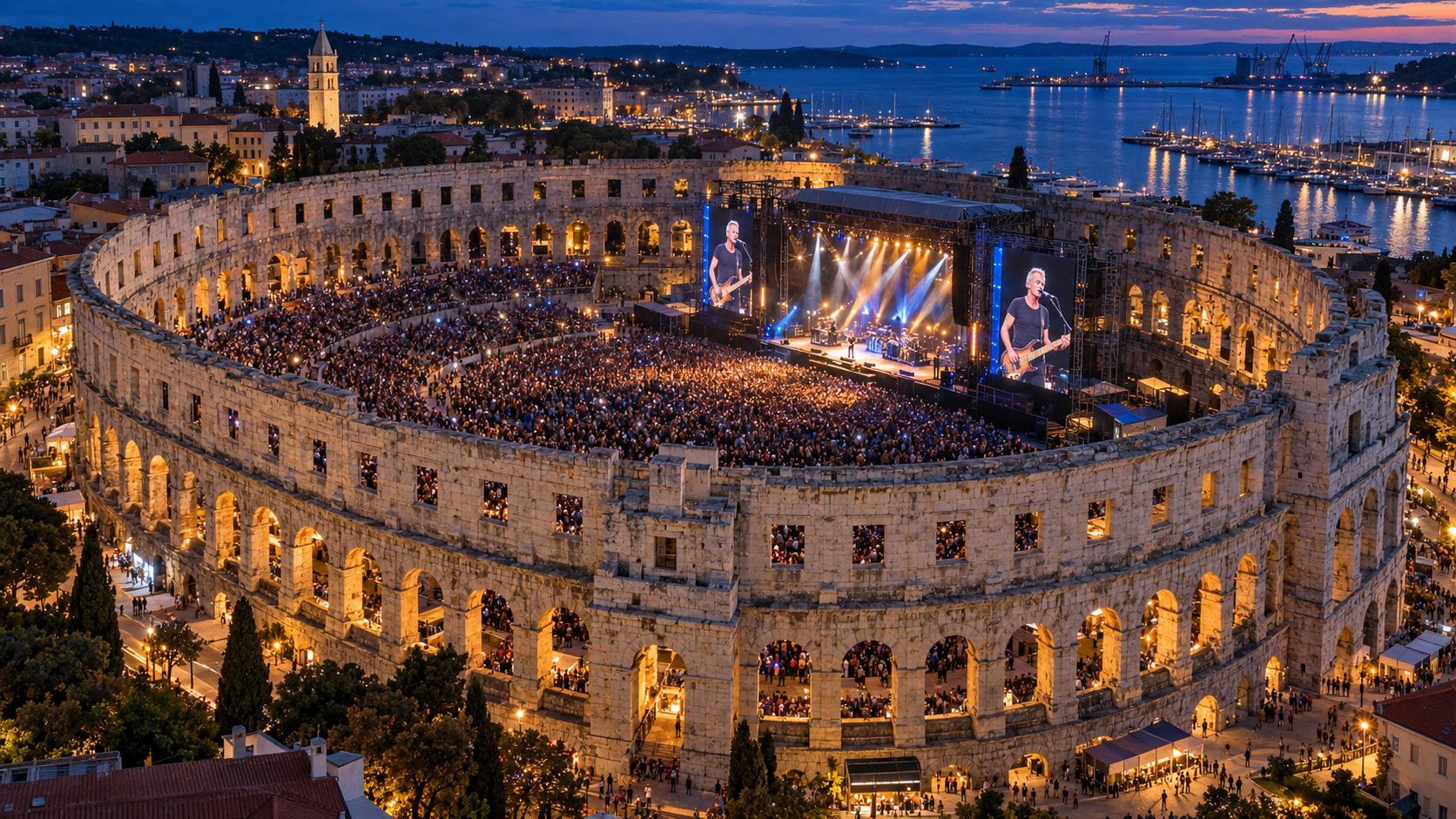
Most venues are built for concerts. Pula Arena was built for gladiators almost two thousand years ago, and it is still standing. Last summer, IVAS Group brought a full international concert production into the Roman amphitheatre in Pula, Croatia. Every truss, cable and speaker had to respect a single rule: the monument comes first.
The Arena is one of the best-preserved Roman amphitheatres in the world, and the only one that still has its complete outer wall. It is built from local limestone, with four towers, and it was once filled with more than twenty thousand spectators. Today it is a protected cultural monument of national significance. For one night, it was also a concert hall with a world-class sound and light system, two giant screens and a full arena of people singing along under the evening sky.
01A stage inside a monument
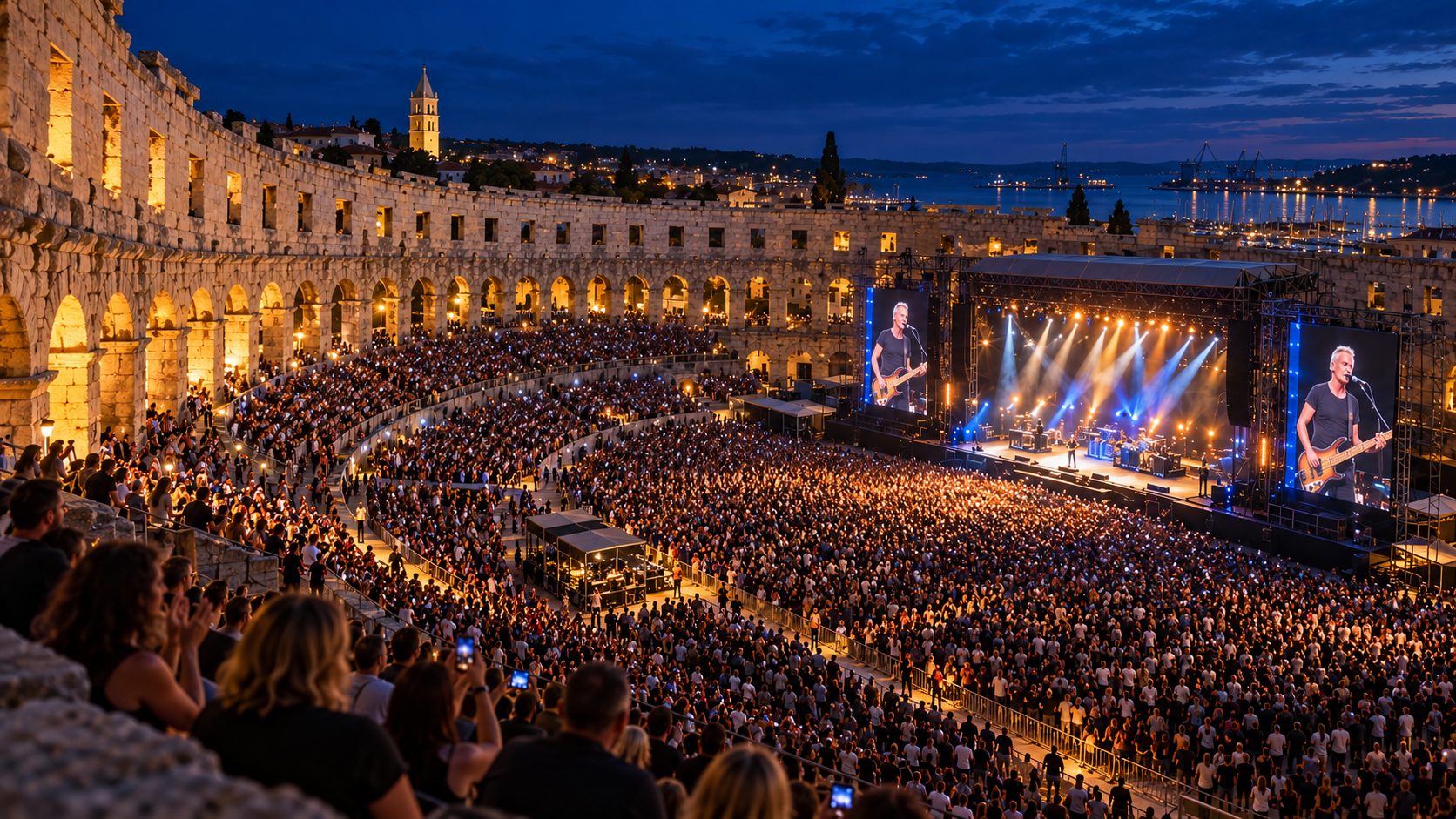
2026 was the first season under Pula’s new rulebook for events in the Arena. The city capped concerts at 8,000 visitors. The Archaeological Museum of Istria now oversees how stages, roofing and structural equipment go in, and a single contractor installs the stage roof for the whole season, so heavy machinery moves through the monument as rarely as possible. The message from conservators was clear: the biggest risks come from moving equipment and from sound vibration.
For IVAS Group, that turned a concert into a heritage project. Our team handled production, sound, lighting and video. We planned every load-in route, every cable run and every speaker position with the museum’s experts and the season’s stage contractor, before a single case came off a truck.
In most venues, we bring the drama. In Pula, the venue brings it. Our job was to protect it, light it and then step out of its way.
IVAS Group production team
02Four problems, four solutions
Nothing may touch the stone
In a normal arena, you hang speakers and lights from the roof and fix screens to the walls. In Pula, you cannot drill, anchor, clamp or lean anything against two-thousand-year-old limestone. Even a ladder resting against an arch is a conversation with a conservator.
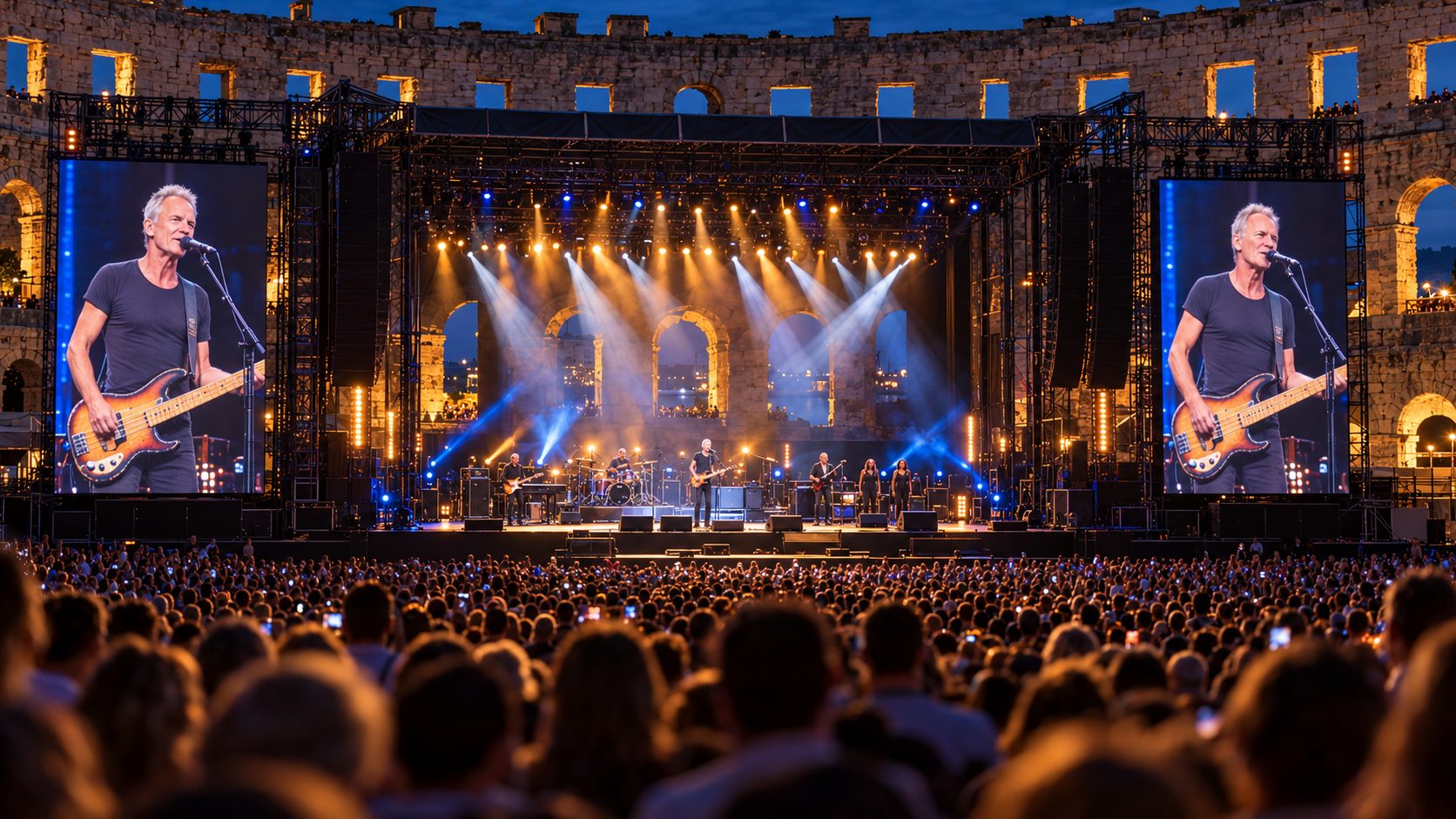
Everything stood on its own feet. Sound and lights flew from the season’s free-standing stage roof. Our two LED screens sat on ground-supported towers with ballast instead of fixings. The arena floor was covered with protective boards and load-spreading plates before anything heavy rolled in. Wherever stone and steel came near each other, soft buffers kept them apart. When we left, the only trace was swept dust.
Sound that respects the walls
An amphitheatre is a giant acoustic bowl. It sounds wonderful, but low frequencies travel straight into the stone. The headliner needed a powerful, full-range show, and the monument needed calm.
We designed the system to aim energy at people, not at walls. The line arrays were angled into the audience, and the subwoofers were set up in a cardioid pattern, which keeps bass off the stage and away from the stone behind it. Vibration sensors on the walls sent live readings to the front-of-house desk, with limits agreed in advance with the conservators. The crowd got the show; the walls got a quiet night.
A load-in through Roman gates
The Arena sits in the middle of the old town, and its gates were designed for people, not for forty-foot trucks. By day, it is also one of the most visited sights on the Adriatic coast. We could not close it for a week of building.
The trucks stopped at a staging area outside the centre. Smaller vehicles shuttled the equipment in, case by case, sized to fit the gates. Most of the build happened at night, so the Arena could stay open to visitors during the day. Every route was walked and measured in advance, so no case ever came near an arch.
N = night shift, D = day. Gold marks the show itself. By the sixth morning, the Arena was back to tourists and a joint inspection with the museum.
Light the stone, without touching it
The most beautiful set in Pula is the Arena itself, so we wanted the arches glowing gold behind the band. Lighting a monument usually means fixing lamps to it, and that was impossible here.
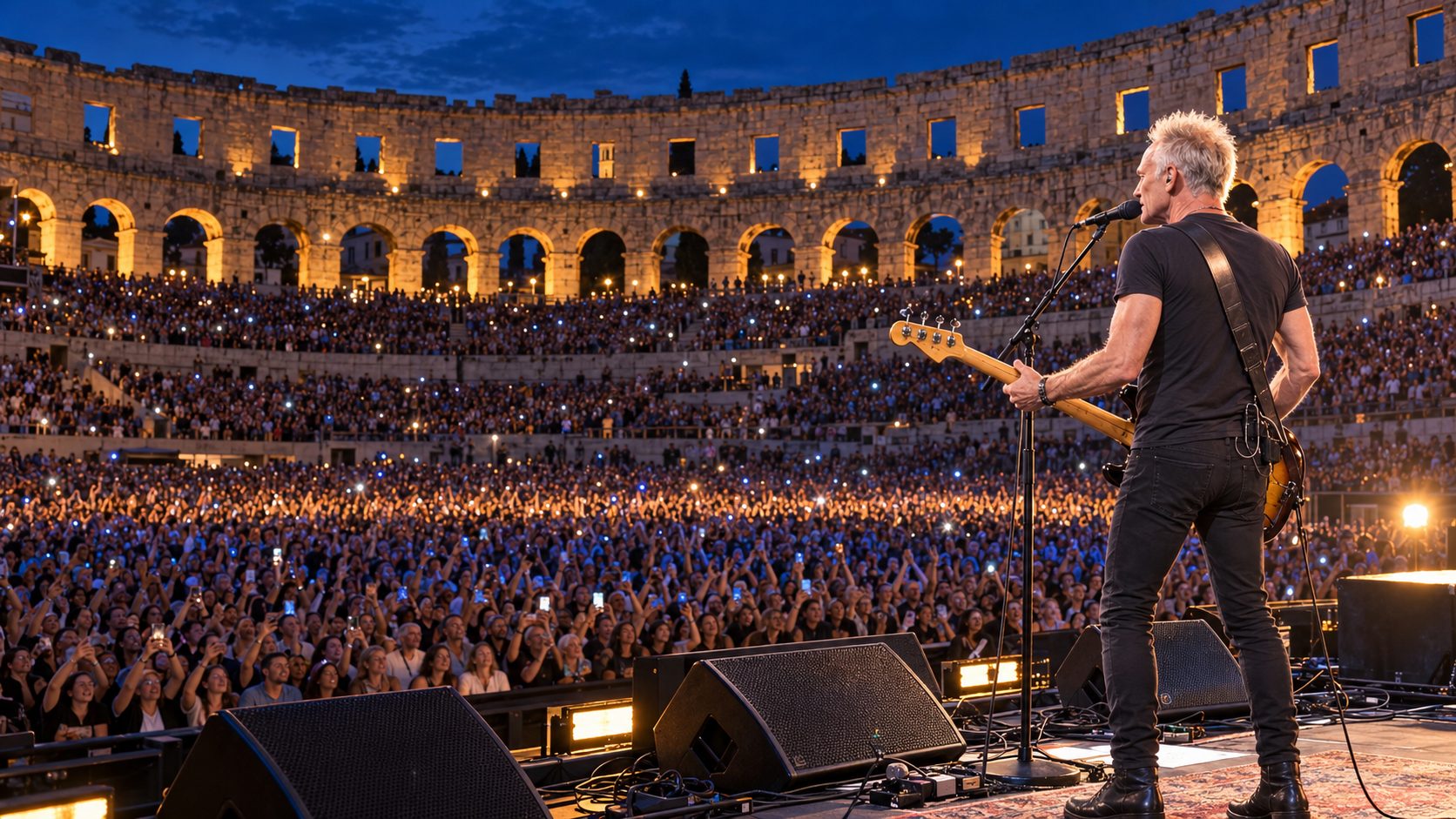
Low-heat LED fixtures stood on the arena floor and the tiers, all free-standing and aimed upwards. They washed the arches in warm amber that matched the old-town lights outside. The stage stayed cool blue and white, so the screens and the stone never fought each other. The result is the image you see on every phone in the crowd.
03The night itself
Doors opened as the sun went down over the harbour. The audience came in through the same gates that Roman crowds once used, and found a stage that seemed to grow out of the stone. When the first chord hit, the Arena did what it has done for twenty centuries: it carried every sound to every seat.
For the crew, the show was the quiet part. The work had been done in the nights before: in measured routes, in agreed limits, in every piece of equipment that stood on its own feet. During the show, our people watched the vibration readings as closely as the mixing desk.

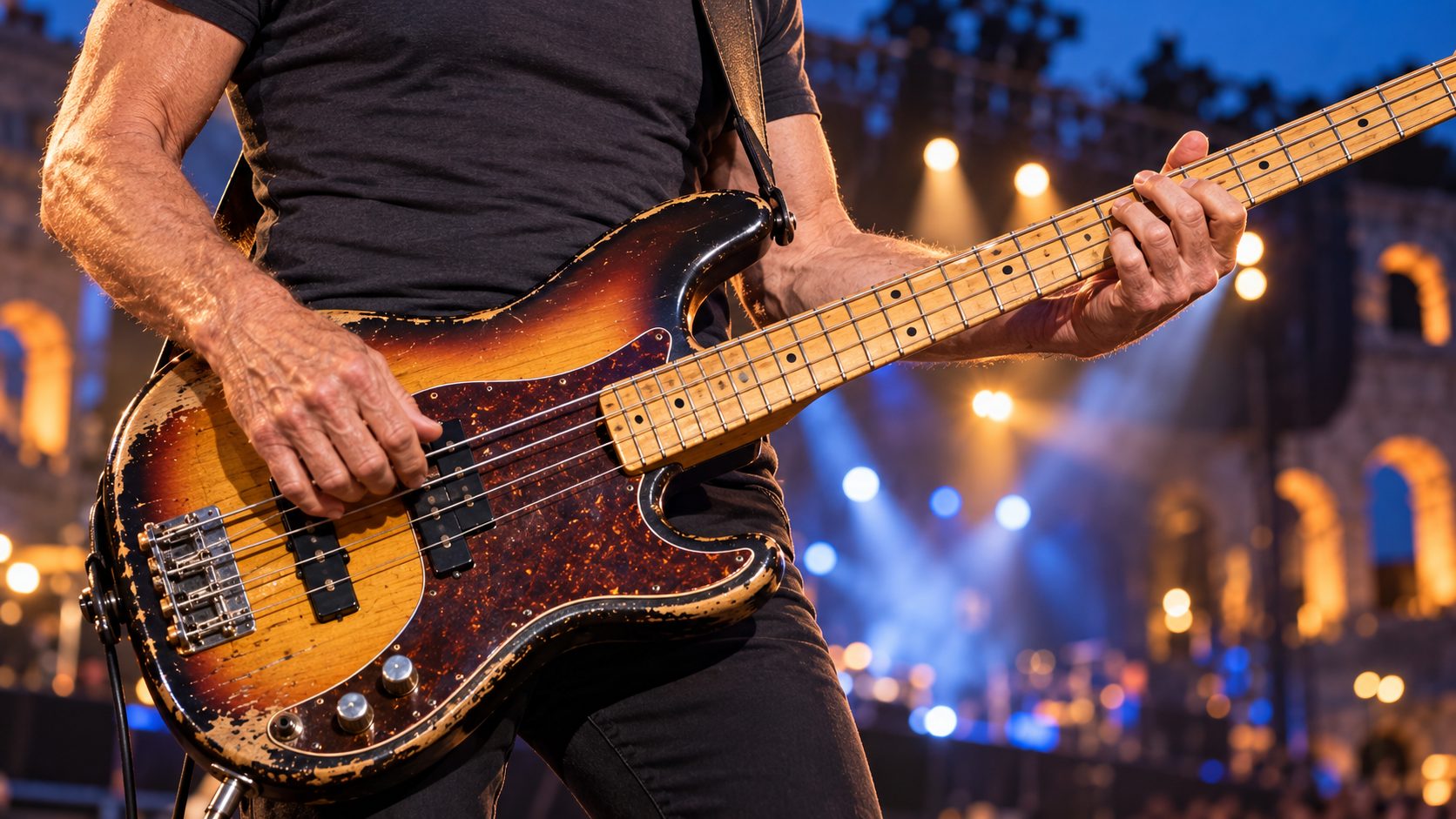
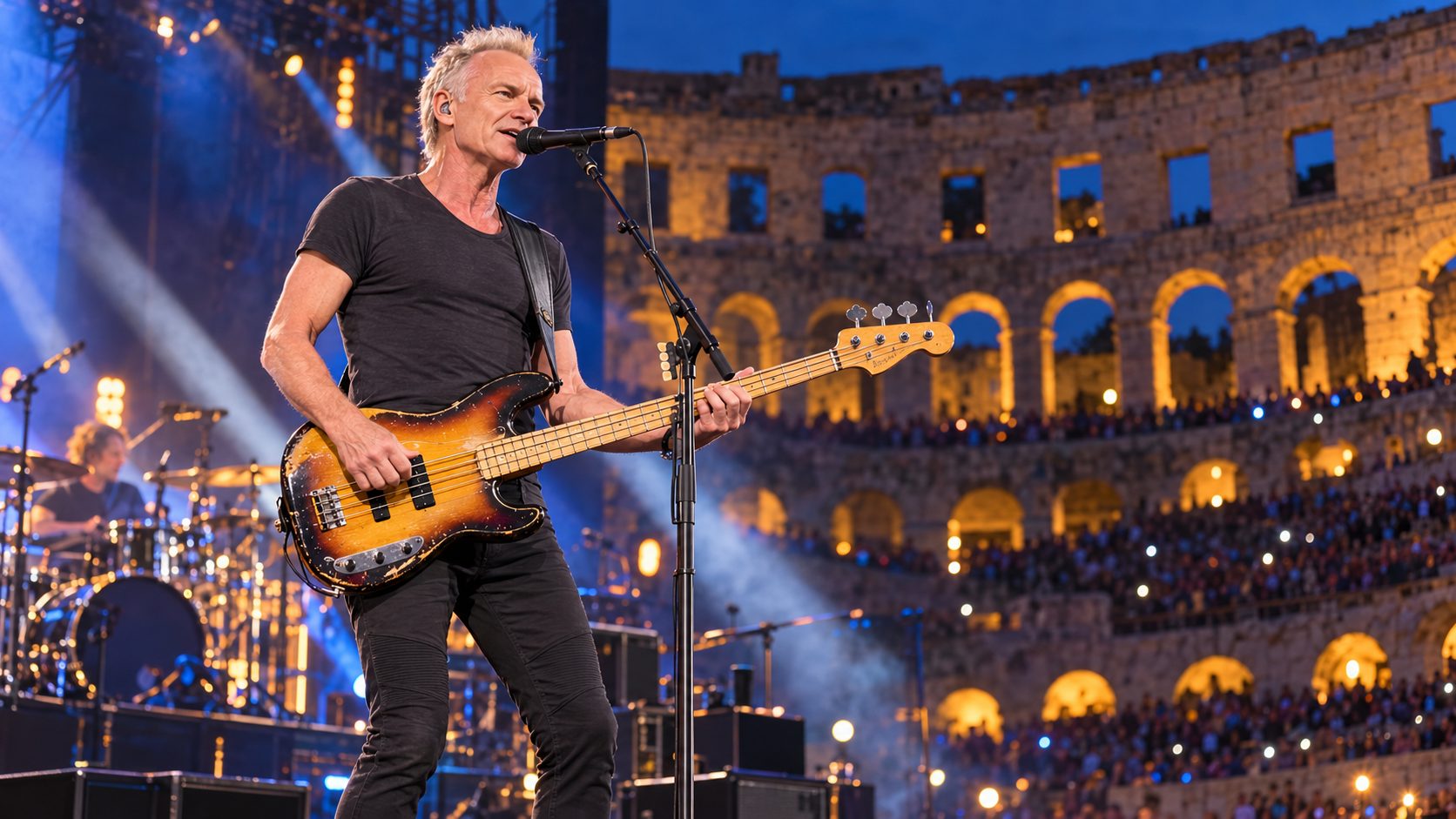
04Voices from the arena
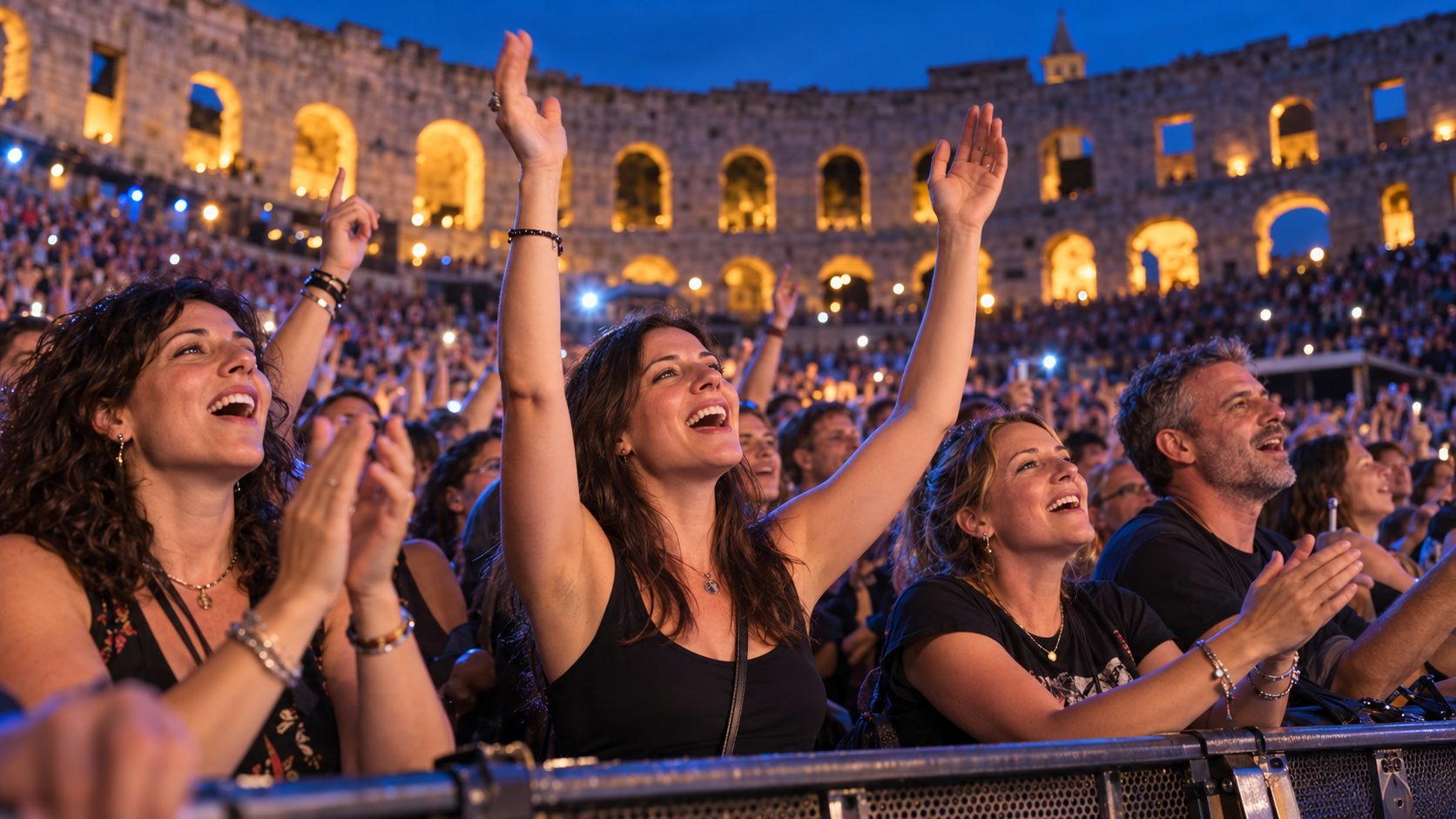
[Add a real visitor quote here: what the night felt like, in their words.]
First nameCity, country
[Add a real visitor quote here: the moment they will remember.]
First nameCity, country
[Add a real visitor quote here: hearing music inside a Roman arena.]
First nameCity, country
05What Pula taught us
Heritage venues reward the teams that prepare the most. Pula made us rethink habits we no longer question in modern arenas: where we hang things, how heavy a case can be, how loud a room is allowed to get. The answers became a method we now use on every historic site we work in. Survey first, design around the stone, agree limits with the people who protect it, and measure everything while the show is running.
The Arena has hosted gladiators, opera, film festivals and rock concerts. It will host many more nights after ours. Our goal was simple: that it would look exactly the same the next morning, and that nobody who was there would ever forget the night before.
Planning an event in a place with history?
Talk to IVAS Group about producing it with the care it deserves.